Korea's physical AI moment is bigger than memory chips.
Ethan Cho joined CNBC to discuss Jensen Huang's vision for South Korea's robotics and physical AI sectors, and why Korea's next AI advantage may come from the real-world industries where intelligence leaves the screen.
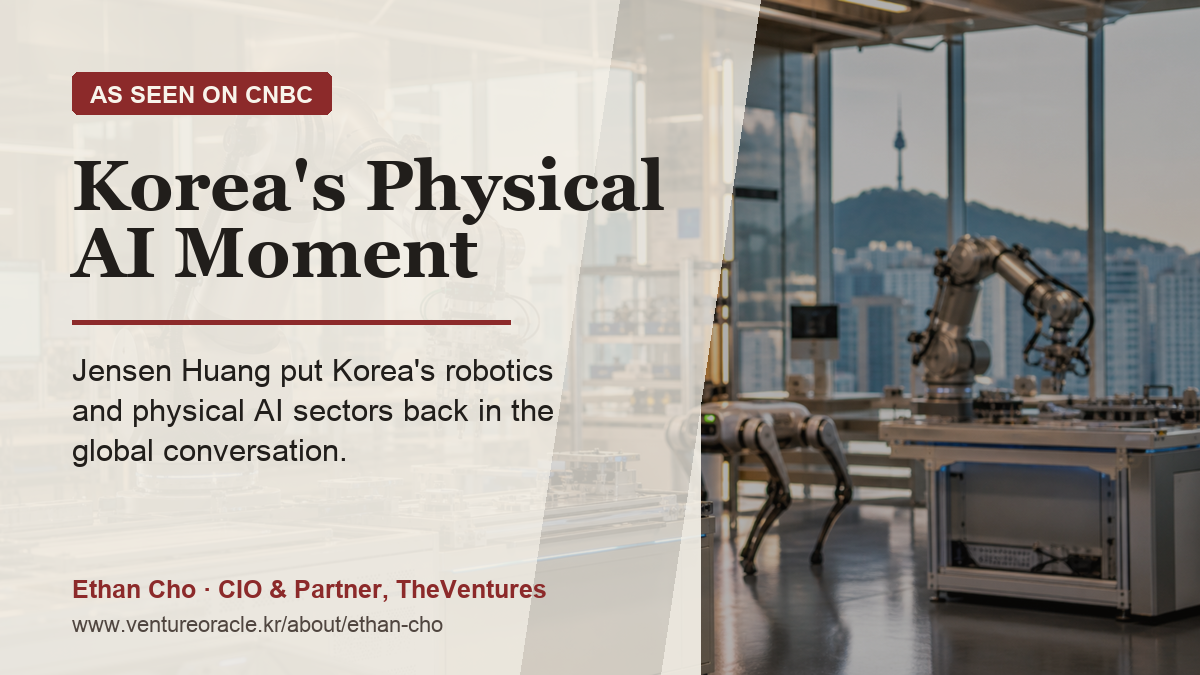
Source Signal
Jensen Huang's vision for South Korea's Robotics & Physical AI sectors
Ethan Cho, Partner at TheVentures, talks about Jensen Huang's strategic vision in the robotics and physical AI spaces on the back of his trip to South Korea, as well as how the Korean market could benefit.
Source: CNBC video page, published June 8, 2026.
The PR thesis to repeat
Not only chips
Korea's AI narrative is too narrow if it stops at memory and supply chain. The stronger story is the full industrial stack.
Industrial density
Factories, logistics, vehicles, hospitals, electronics, batteries, and robotics give Korea compressed testbeds for embodied AI.
Productivity pressure
Demographics and labor scarcity turn robotics from a gadget story into a national productivity and competitiveness story.
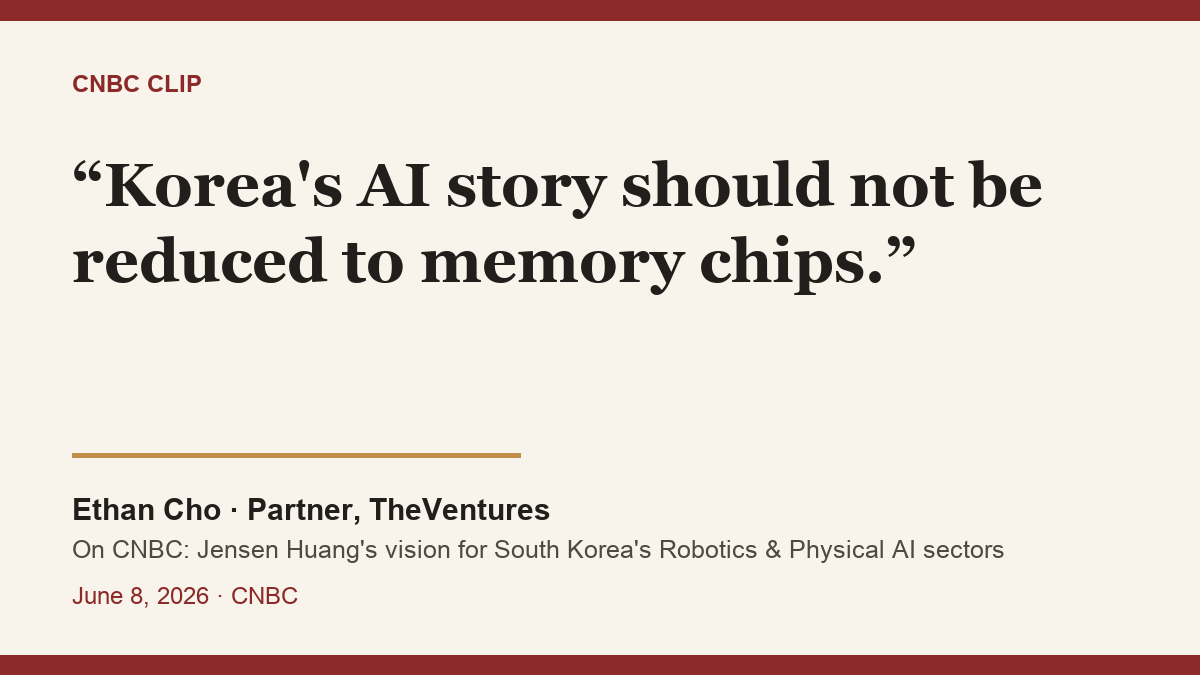
Quote-ready positioning
Korea's AI story should not be reduced to memory chips. The more interesting question is whether Korea can turn its industrial base into a physical AI advantage.
Use this line when pitching follow-up commentary, panels, podcasts, and founder-facing posts. It is simple enough for media, but specific enough to own the category.
Fast bio for follow-up media
Ethan Cho (조여준) is Chief Investment Officer and Partner at TheVentures, an early-stage Korean venture capital firm. He writes on AI-native venture capital, Korea-to-global startups, and how Korean industrial strengths can translate into global AI advantage.